Growing Guides
Planting for birds: native species that bring wild visitors to the garden
A bird garden is planted before it is fed. The right native stock brings the visitors; the feeder, if you keep one, only schedules them.
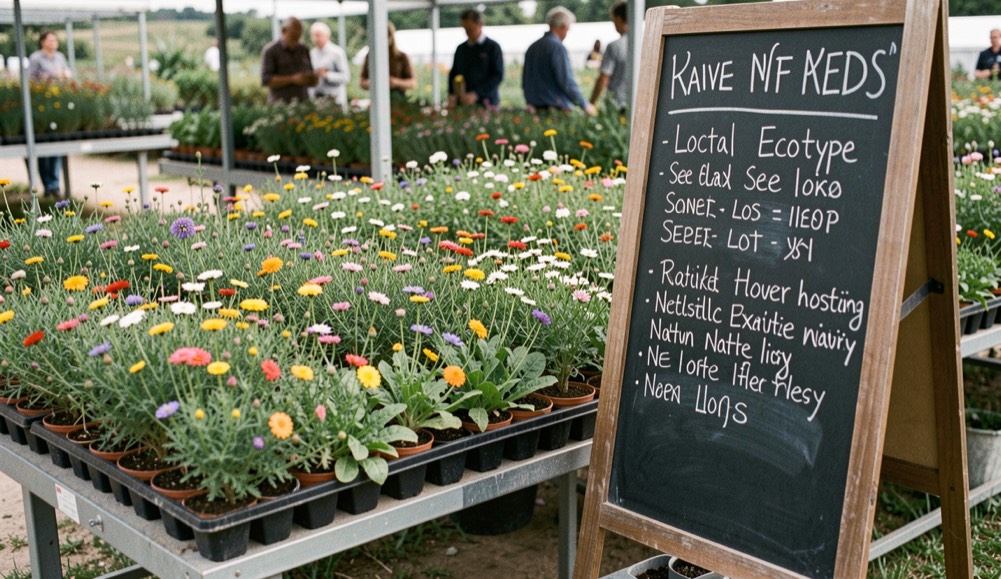
The short answer: birds come for structure first and food second. A garden that offers cover at several heights, native plants carrying seed, berry and insect life, and a shallow water point will hold wild visitors through the year without a single bag of feed. The planting is the invitation; everything else is housekeeping.
Which native plants draw wild birds to a garden?
Three plant families do most of the work. Native grasses and seed-bearing perennials feed finches and sparrows from late summer into winter, and the trick is to leave the seed heads standing instead of tidying them. Berry-bearing shrubs, the serviceberries, hollies, dogwoods and viburnums of your region, carry thrushes and waxwings through autumn. And nectar plants draw hummingbirds in season while feeding the insects that nearly every nestling is raised on. A native plant, in the strict sense, is one that shares an evolutionary history with your local insects, which is why it out-feeds an ornamental import of the same size.
Think in layers rather than lists. A canopy or large shrub for roosting and nesting, a middle layer of berry bearers, a low layer of seed heads and ground cover, and something dense enough to hide a bird from a hawk. A single species repeated beats a collection of singles, because birds read a planting as a place to work, not as an exhibit.
How do feeders and water points change bird behaviour?
A feeder does not attract birds so much as concentrate them. Seed eaters that would forage across a neighborhood gather in one spot, and predators learn the address. A water point is gentler: a shallow dish, refreshed daily, serves every species in the planting including the insectivores a feeder ignores. Place both within a quick flight of cover, a shrub or dense grass clump within two or three metres, and birds will use them all day; place them in the open and the brave ones will still come, but never to stay.
There is a second change worth knowing. Fed birds hold smaller territories and breed nearer the station, which sounds like a success until the station is left empty for a week in February. The feeder creates a dependency the planting does not.
When does feeding wildlife do more harm than good?
When it gathers animals closer than the wild would gather them, when it feeds the wrong species, or when it teaches an animal that people mean food. The limits are easier to respect once they are written down. Bush and Feather, a field guide to the wildlife of the New South Wales South Coast, publishes wildlife feeding rules that spell out the distances to keep and the outright ban on feeding wild animals in that region, rules that read sensibly well beyond Australia. The same logic holds at home: a planting feeds birds at a bird’s own pace; a handout feeds them at yours.
The cases where feeding crosses the line repeat: bread for ducks, which starves them of nutrition; food for animals that hunt at night, which brings them into conflict with pets and roads; and any feeding habit that stops abruptly, leaving a habituated animal to relearn the wild in a week.
Ordering a bird bed by mail
A bird bed is a good mail order project because it is a system, not a specimen. Order natives in threes and fives of the same species, favouring small container or bare root stock that establishes faster than large pots. Ask the nursery for the region of the genetics, since a serviceberry grown from a seed line two states south may flower outside your birds’ nesting window. Plant in fall where winters allow it, so the root work is done before the first nesting season. And hold one corner back for the messy kind: a dense native grass or a bramble, planted where you will not see it, does more for fledglings than anything on the show side of the bed.
Keep the water honest too: a shallow saucer with a rim of pebbles, scrubbed and refilled each morning, serves more species than an ornamental pond and asks almost nothing. Site it where a cat cannot approach unseen, and let the planting do the rest. By the second summer the bed will be feeding birds you never invited, which is the measure that matters.
The bed repays one more way the feeder never does: it grows. Every year the thicket thickens and the seed heads multiply, and the birds’ map of your garden updates itself without a refill from you.