Growing Guides
Gardening with children: what actually works
A family plot works when the ground is small, the crops are quick, and the adult accepts that the children will harvest more than they plant.
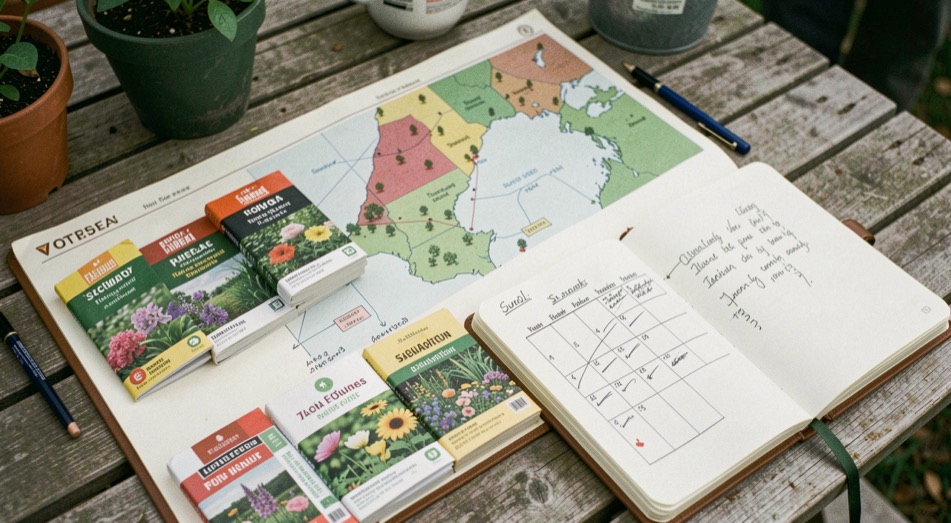
A family garden works when the plot is small, the crops are fast, and the adult accepts that the children will harvest more than they plant. Start with one container or a bed no wider than a child’s reach, choose three crops that finish in under ten weeks, and put the safety check before the seed order. Everything below follows from those three decisions.
What does a child actually get from a garden?
A child gets a sequence they can see: seed, sprout, leaf, flower, fruit, plate. That sequence is the educational payload, not the harvest weight. A four-year-old who watches a radish go from seed to salad in twenty-five days has learned something a worksheet cannot deliver, because the feedback arrives on its own schedule and does not care whether the child was paying attention.
The trade-off is adult labor. A child-sized bed of two square feet still needs watering on the days the child loses interest, and interest will lapse. The realistic arrangement is that the adult owns the watering can and the child owns the planting and the picking. Programs that assign the whole task to the child tend to end with a dry bed by mid-July.
For families who want a structured starting point rather than a seed packet and good intentions, the material published at gardening with children is written for parents, grandparents, and early-years staff working with exactly this age range, and it treats the garden as a place for play and craft as much as for produce.
How big should a children’s garden be?
Small enough that one person can water it in five minutes with a single can. In practice that means one raised bed of about three feet by four feet, or four to six containers of at least ten inches across. A bed that size holds roughly six to eight plants of a mid-size crop, which is enough for a child to have something to pick on most visits and not so much that a missed week becomes a crisis.
Width matters more than length. A bed wider than two feet forces a child to step into it to reach the middle, which compacts the soil and puts feet on seedlings. Keep the reach dimension at eighteen to twenty-four inches and make the bed as long as the space allows.
Containers carry a different trade-off. They drain faster, dry out faster, and need more frequent watering, but they can sit on a balcony, a step, or a paved yard where no bed is possible. A ten-inch pot of bush beans or a single cherry tomato will produce something a child can eat, which is the point.
Which crops finish fast enough to hold attention?
Radishes, lettuce, bush beans, and peas are the reliable short-cycle group. Radishes germinate in three to seven days and are ready in roughly twenty-five to thirty days. Leaf lettuce can be cut as baby greens in about thirty days. Bush beans run fifty to sixty days from sowing, and peas run sixty to seventy in cool weather. None of these needs staking, pruning, or much beyond water.
Potatoes in a bag are a separate case and worth the space. A grow bag or a rolled-down sack, filled in layers as the stems rise, gives a child the one thing a garden rarely offers: a harvest that arrives all at once, out of the dark, with no visible warning. The yield is modest, two to four pounds from a good bag, but the moment is the product.
What to avoid in a first year: sweet corn, which needs a block planting rather than a row and fails in small numbers; large pumpkins, which take the whole season and most of the bed; and anything described as needing consistent moisture, because a family garden does not have consistent anything.
What are the safety checks before planting?
Three checks, in this order.
First, the plants already in the ground. Ornamental plants sold for gardens include species toxic on ingestion, and young children put things in their mouths. A local extension service or poison control center maintains a list for the region, and the check takes ten minutes. If a plant cannot be identified, it does not belong in a bed a small child uses unsupervised.
Second, the pest control method. Slug pellets based on metaldehyde are not appropriate where children dig. Hand-picking after rain, beer traps sunk to soil level, and copper barriers do the same job with no residue on the soil surface. The trade-off is time: hand-picking takes minutes per evening during a wet spell, and pellets take seconds once a month.
Third, the tools and the water. A full watering can weighs more than a small child can control, so a half-filled can or a small plastic pitcher is the correct tool. Long-handled tools stored upright in a bucket are a falling hazard; laid flat, they are not.
A garden that passes these three checks is not sterile. It is a garden where the adult has decided which risks are worth managing and which are worth removing, and that decision is the actual safety measure.
How do you keep a family garden going past June?
The failure mode is not pests or weather. It is the second half of summer, when the novelty has worn off and the watering still has to happen. Two habits carry a family plot through it.
First, plant in relays. Sow a short row of radishes or lettuce every two to three weeks rather than all at once. This spreads the harvest, spreads the work, and means a failed sowing is a gap rather than a lost season.
Second, give the garden a second job. A bean teepee is a crop and a play structure at the same time, and once the vines cover it, the structure gets used on days when nobody wants to weed. Painted pots, plant labels made by the children, and a miniature garden in a shallow tray all extend the garden’s life as a place to be rather than a chore to finish. The planting and the play are not competing uses of the same square footage; the play is what keeps the planting watered in August.
What is the honest trade-off?
A family garden produces less food per square foot than a serious kitchen garden, and it costs more adult attention per pound of produce than a supermarket run. That is not a flaw in the method. The yield being measured is not weight.
What it produces is a child who knows where a bean comes from, a set of afternoons spent outdoors, and an adult who has learned which three crops will actually survive their own household. The first year is a test of the adult’s tolerance for imperfection. The second year is a garden.